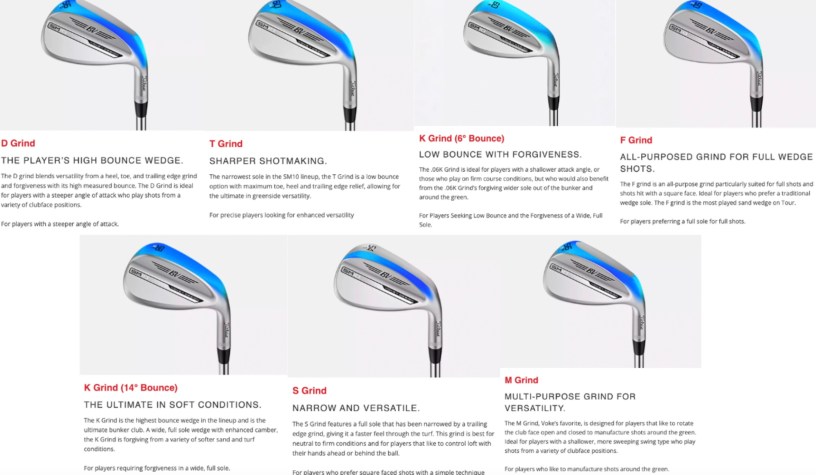
Most golfers obsess over the loft of their wedges focusing on 52°, 56°, or 60, but the numbers on the bottom of the club are often more important than the ones on the face. If you’ve ever hit a “fat” chip on a perfect fairway or watched a ball blade across the green from a bunker, you likely had a bounce or grind mismatch.
The Physics of Bounce: Your Anti-Dig Insurance
Bounce is the angle created between the leading edge and the lowest point of the sole. Think of it as the “skid plate” of your golf club. Its primary job is to manage how the club enters and exits the ground.
- Low Bounce (4°–6°): Designed for precision. These are best for golfers with shallow “sweeping” swings or those who play on firm, sun-baked turf.
- Mid Bounce (8°–12°): The “all-rounder.” This provides enough forgiveness for most turf conditions and swing types, making it the standard for gap wedges.
- High Bounce (14°+): The ultimate stabilizer. If you have a steep “digging” swing or play in soft, lush conditions, high bounce prevents the leading edge from getting stuck in the mud.
Decoding the Grind: Shaping Your Creativity
While bounce is about the angle, the grind is about the architecture of the sole. Manufacturers “grind” away metal from the heel, toe, or trailing edge to change how the club sits at address.
A specialized grind allows you to:
- Open the Face: Relieving the heel allows the leading edge to stay low to the ground even when the face is wide open, perfect for “flop” shots.
- Increase Forgiveness: A wider, fuller sole grind acts like a safety net on full shots from the fairway.
- Navigate the Sand: Specific grinds are shaped to “splash” sand more efficiently, helping the ball pop out of bunkers with ease.
Your Swing, Your Sole
The “perfect” wedge doesn’t exist in a vacuum—it only exists in relation to your swing.
- The “Digger”: If you take large, deep divots, you need more bounce and a wider sole to keep the club moving forward.
- The “Slider”: If you barely ruffle the grass, less bounce and a thinner sole will help you nip the ball cleanly off the turf.
The Course Connection
Your local environment is the final piece of the puzzle. A player in the firm, links-style conditions of the desert needs a very different setup than a player navigating the soft, thick rough of the Southeast. Ideally, your wedge set should be a “toolbox” with different bounces to handle whatever the course throws at you.
Elevate Your Scoring Potential
When your wedges are synchronized with your swing and your turf:
- Confidence Increases: You no longer fear the “tight lie.”
- Spin Becomes Predictable: Clean contact leads to consistent friction and better “stop” on the green.
- Bunker Play Becomes Simple: The club does the heavy lifting in the sand.
Stop guessing and start scoring. Don’t let a mismatch in equipment hold back your short game. Let’s take a look at your divot pattern and your local course conditions to find the specific bounce and grind combination that will shave strokes off your next round.
Visit us today for a wedge consultation at Fairway Golf
 Fairway Golf Blog