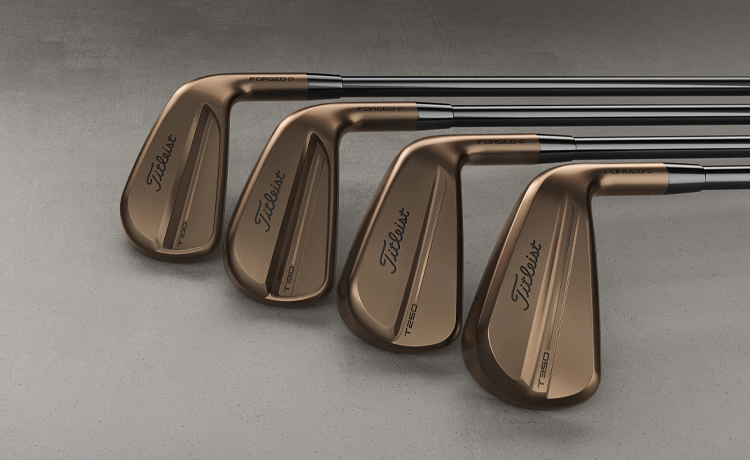
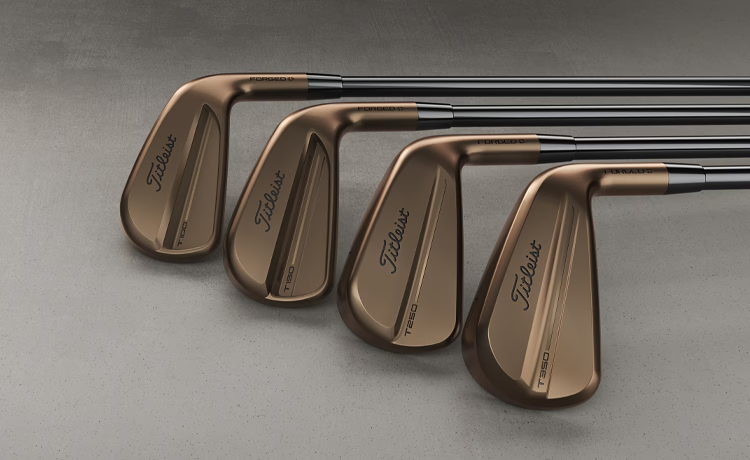
The Titleist T-Series irons have long been the benchmark for precision, forged feel, and tour-level performance. Now, for the first time ever, Titleist is releasing the T100, T150, T250, and T350 in a Limited Edition Oil Can finish — a rich PVD copper treatment made iconic by Vokey Design wedges, now brought to the full iron lineup. Four models. One unmistakable look. The same uncompromised T-Series performance underneath.
Overview
The Titleist T-Series has anchored the company’s iron lineup since its introduction, covering the full range from pure tour-level muscle to high-launch game improvement — all built to a consistent standard of precision and performance. What the Oil Can finish does is take those four architecturally distinct models and unify them visually through a PVD copper treatment that is immediately recognizable as something rare and intentional.
This is not a special colorway on a mass-produced head. The Oil Can finish begins with the same forged, cast, and precision-manufactured T-Series heads that Titleist builds for every standard configuration, then receives a Physical Vapor Deposition treatment that bonds a rich, warm copper-brown coating at a molecular level. The result is a finish that is as durable as it is distinctive — PVD does not chip or peel like paint, and the copper character of the finish will hold through a full season of rounds without degrading.
Each model also ships with a coordinated equipment package: True Temper AMT Onyx steel shafts in the appropriate weight and profile for each iron head, finished in a matching onyx powder coat, paired with an Oil Can-inspired Golf Pride Z-Grip. The setup is cohesive and considered — nothing about this release feels assembled from generic components.
The Oil Can Finish: What PVD Treatment Means and Why It Matters
The Oil Can finish has a specific history at Titleist. Vokey Design has offered Oil Can as a specialty finish on SM-series wedges for years, developing a dedicated following among players who appreciate the visual warmth of copper tones over a chrome or satin surface. This is the first time Titleist has extended that treatment to the iron line.
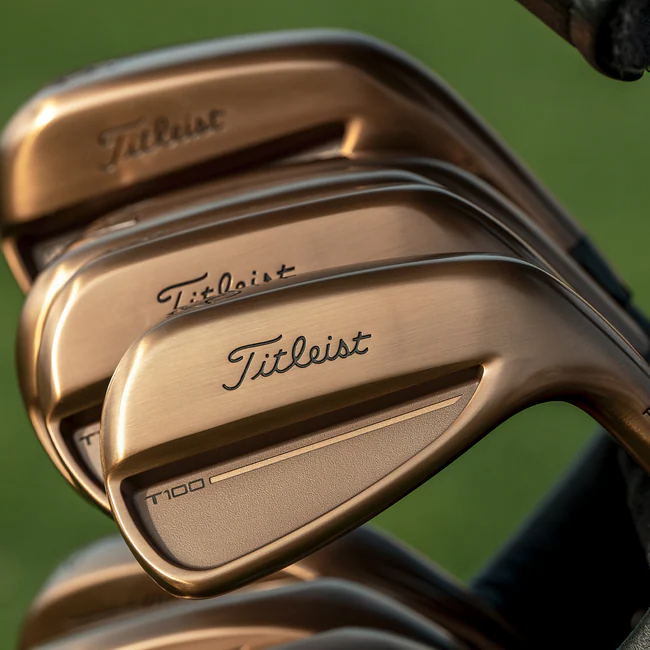
PVD — Physical Vapor Deposition — is a vacuum-based coating process in which a metal source material is vaporized and deposited onto the club head at the atomic level. The result is a coating that bonds directly to the steel substrate rather than sitting on top of it, which is why PVD finishes are fundamentally more durable than paint, lacquer, or electroplating. At impact, in the bag, on concrete paths between holes — the finish maintains its integrity across all of it.
The visual effect is a rich, deep copper-brown that reads differently in different conditions. In direct sunlight the finish has warmth and depth. In overcast conditions it settles into a darker, more muted tone. At address, the Oil Can surface eliminates glare in a way that matte chrome does not — there is no reflective flash off the topline when you set the club behind the ball. Golfers who find chrome distracting will notice the difference immediately.
The coordinated True Temper AMT Onyx shafts complete the visual system. Each model receives a different AMT Onyx variant — the T100 ships with AMT Tour White Onyx, the T150 with AMT Tour Silver Onyx, the T250 with AMT Black Onyx, and the T350 with AMT Red Onyx. These are all performance AMT shaft profiles appropriate to each iron’s head weight and swing speed target, finished in onyx powder coat so the shaft matches the tone of the head.
Construction and Technology — What’s Inside Each Model
The Oil Can finish changes the visual experience of the T-Series. The performance underneath remains exactly what Titleist has built across four distinct iron architectures, each engineered for a different player profile. Here is what makes each head work.
T100 Oil Can — The Player’s Iron
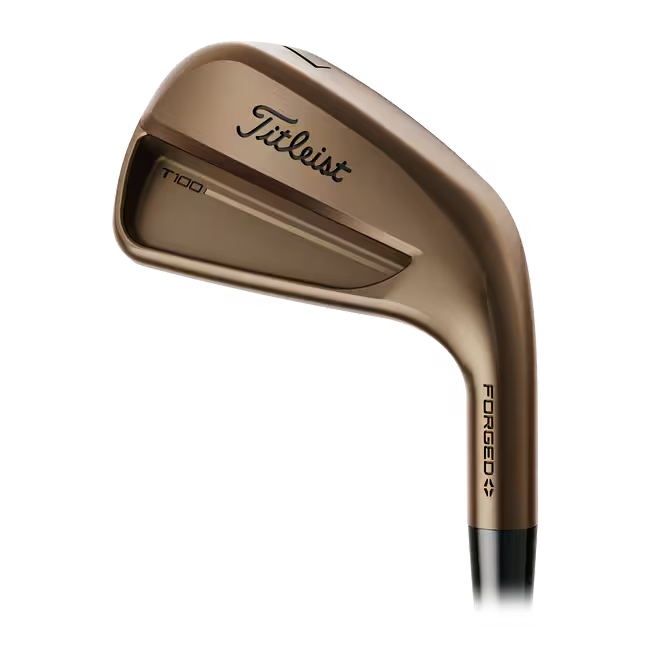
The T100 is Titleist’s pure player’s iron — the most compact, most feedback-oriented, most workable head in the T-Series. It is built on a fully forged dual cavity construction with Split High-Density Tungsten weighting, using D18 density tungsten set via a 2000°F aerospace brazing process that eliminates weld points and allows Titleist’s engineers to place mass with extreme precision. The result is a CG location that produces a low, penetrating ball flight with the precise trajectory control that single-digit players and tour professionals demand.
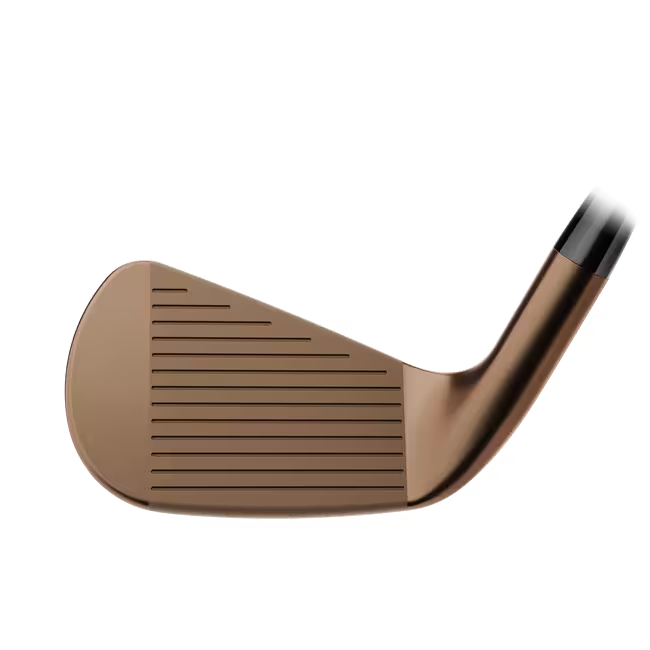
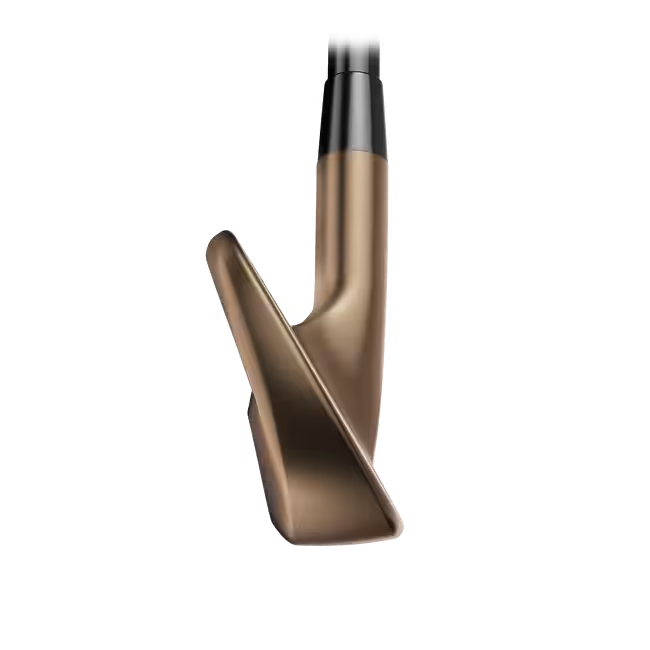
The current T100 incorporates a muscle channel in the 3- and 4-iron for higher long-iron launch, refined Variable Face Thickness (VFT) for more consistent carry distance across the face, and more aggressive groove geometry in the mid and short irons for improved spin consistency from rough lies. At address, the profile is exactly what tour players specify: thin topline, minimal offset, compact blade length, finished here in Oil Can copper rather than standard Brushed Chrome. The visual character is entirely different. The performance character is identical.
The T100 Oil Can ships with True Temper AMT Tour White Onyx, available in R300, S300, and X100 flex — a low-launch, low-torque steel shaft profile appropriate for the penetrating flight this iron is engineered to produce.
T150 Oil Can — The Faster Player’s Iron
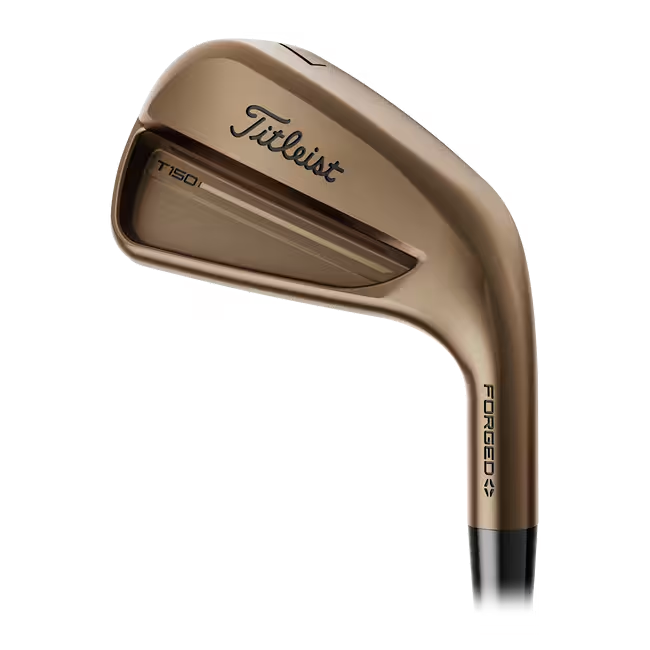
The T150 sits immediately above the T100 in the T-Series hierarchy — still a player’s iron by architecture, but with 1° stronger lofts throughout, a new Muscle Channel design extended through the 7-iron, and progressive groove design across the set for more consistent spin. The head is slightly larger than the T100, which provides a more confidence-inspiring address profile for players who want the aesthetic and feedback of a player’s iron but need a small margin of additional forgiveness and ball speed.
The T150 launches mid-high relative to the T100’s low trajectory, which makes it genuinely useful for players who find the T100 flight difficult to sustain with long irons. The 1° loft advantage over the T100 accumulates across the set in a way that produces measurable carry differences without changing the fundamental feel or shaping capability of the iron.
The T150 Oil Can ships with True Temper AMT Tour Silver Onyx in Stiff and X-Stiff flex — a mid-launch steel profile appropriate for the slightly higher trajectory this model is calibrated to produce.
T250 Oil Can — The Player’s Distance Iron
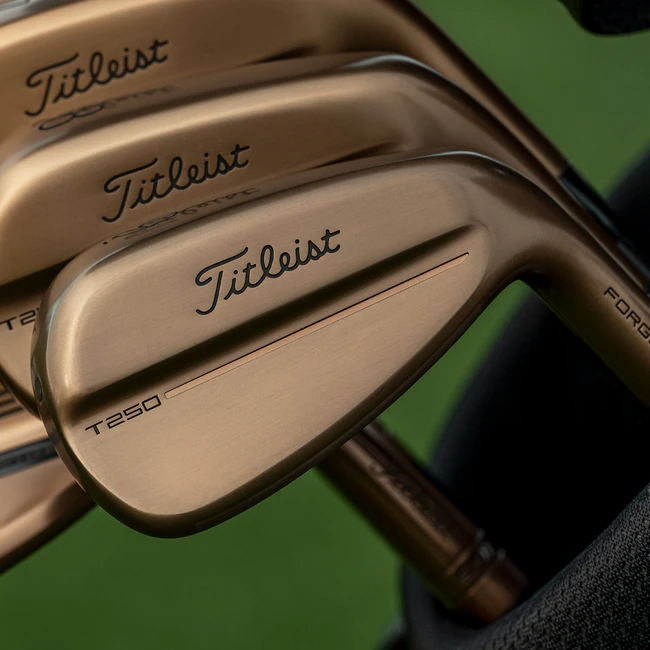
The T250 represents a meaningful architectural step from the T100/T150 family. Where those irons are built around a forged dual cavity construction focused on feel and precision, the T250 is engineered around a forged V-Taper L-Face design and Max Impact Technology — a high-strength steel construction optimized for elevated ball speed and higher launch without sacrificing the clean, player-influenced look at address that distinguishes T-Series irons from more overtly game-improvement alternatives.
The V-Taper L-Face design is the performance core of the T250. The L-shaped face geometry and variable taper across the face allows Titleist’s engineers to maximize face deflection across the hitting zone — more of the face is actively contributing to ball speed, which translates to more consistent carry distances on center and off-center strikes alike. Max Impact Technology further enhances carry consistency by optimizing the energy transfer from face to ball across a wider impact window.
The T250 starts at 4-iron rather than 3-iron, which is the correct decision for this architecture — the CG characteristics of this construction are better suited to 4-iron through PW/GW range. The T250 is also one of Titleist’s most popular blended-set irons: players commonly carry T100 or T150 in the short irons and transition to T250 in the mid and long irons where launch and forgiveness matter more.
The T250 Oil Can ships with True Temper AMT Black Onyx in Regular and Stiff flex — a mid-to-high launch steel profile tuned for the trajectory this head is designed to produce.
T350 Oil Can — The Game Improvement Iron
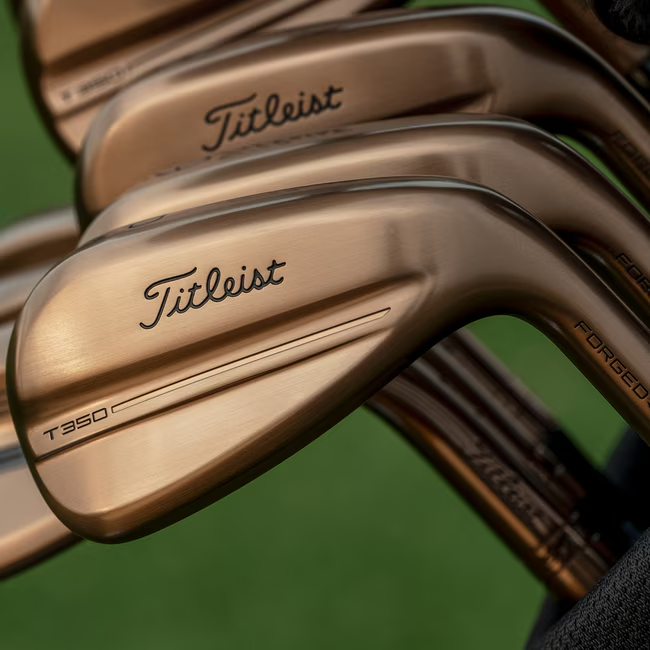
The T350 carries the T-Series design DNA furthest in the direction of forgiveness and maximum performance. The new generation T350 introduces a forged L-Face design with multi-zone taper for elevated ball speed and high launch, improved Max Impact Technology for more consistent carry distance across every impact location, and strategically placed high-density tungsten to lower and centralize the CG for a higher, easier-to-stop ball flight.
The practical difference between the T250 and T350 is not subtle. The T350 produces more ball speed, higher launch, and more forgiveness on off-center strikes — this is the iron for players who need the performance floor of a true game-improvement design but want the visual discipline and T-Series pedigree rather than the aggressive, oversized look of a generic GI iron. The Oil Can finish makes the T350 look unlike any game-improvement iron on the market.
The T350 Oil Can ships with True Temper AMT Red Onyx in Regular and Stiff flex — a mid-to-high launch profile tuned for the higher ball flight this head is optimized to produce. The T350 also offers W2 (53°) wedge configuration, giving players access to the widest gapping range in the T-Series lineup.
📷 → Upload image: Titleist_OilCan_Lineup_01_family.png Caption: The T-Series Oil Can lineup — T100, T150, T250, and T350 each receive the same PVD copper treatment while maintaining their distinct performance architectures.
Oil Can PVD Finish — Durability and Visual Identity
PVD coating is not a surface application. The deposition process bonds the copper-tone material at the molecular level, which means the Oil Can finish on these irons will behave differently from painted finishes through normal wear. There is no risk of the coating flaking off on impact. The finish will develop its own micro-character over time as small contact marks accumulate, similar to the way an oil can wedge develops patina with play — but the base color and coverage will remain intact across the full life of the iron.
Coordinated AMT Onyx Shaft Package
True Temper’s AMT (Ascending Mass Technology) shaft family is engineered around a specific concept: heavier shaft weight in the longer irons for control, lighter weight in the shorter irons for speed — all within a single set. This produces a progressively consistent feel from the 3-iron or 4-iron through the pitching wedge. The Onyx powder coat treatment on each variant of the AMT shaft used in this collection matches the dark, subdued tone of the Oil Can heads. This is not a standard stock shaft with a finish upgrade. It is a shaft selection that was made with both performance and visual coherence in mind.
Golf Pride Z-Grip — Oil Can-Inspired Texture
The Golf Pride Z-Grip is not a standard Tour Velvet. It is a full-cord grip in an Oil Can-inspired color profile — a direct visual and tactile complement to the copper PVD head and dark Onyx shaft. The full cord texture provides excellent moisture management in humid conditions and positive feedback through the grip end throughout the swing. The .600 core size is standard across the lineup.
Same Performance Architecture as Standard T-Series
Every Oil Can iron delivers the same performance characteristics as its standard T-Series counterpart. Titleist did not modify lofts, face profiles, tungsten placements, cavity geometries, or groove specifications to accommodate the Oil Can finish. The player who moves from standard T100 to T100 Oil Can will not need to recalibrate distances, shot shapes, or scoring club gapping. The finish is the difference. Everything else is identical.
Feel and Performance
There is something specific that happens when you put an Oil Can iron in your hand for the first time. The visual warmth of the finish changes your expectation before you even hit a shot — this is not the crisp, reflective presentation of a chrome iron. It is something heavier and more deliberate. That mood carries through at impact.
The T100 and T150 Oil Can irons retain everything that makes forged T-Series irons feel the way they do. The split high-density tungsten in the T100 places mass exactly where Titleist’s engineers specify it, and the dual cavity construction compresses at impact in a way that produces the dense, connected sensation that player’s iron players recognize immediately. Well-struck shots communicate cleanly through the hands — you know what happened without needing to watch the ball. The Oil Can finish doesn’t change that feedback loop. If anything, the matte surface seems to remove visual distraction at address in a way that makes the setup and swing feel more deliberate.
The T250 and T350 play with the speed and launch characteristics their underlying technology produces. The V-Taper L-Face construction in the T250 generates ball speed from a wider zone of the face than a classic player’s iron construction, and that consistency shows up in tighter carry distances across a range of contact qualities. For golfers who play blended sets — T100 in the short irons, T250 from the 5-iron down — the transition between head designs is the most interesting part of the experience. The Oil Can finish makes that transition invisible visually. The head shapes change as expected, but the look of the set is unified in a way that a chrome/chrome combination doesn’t provide.
The Golf Pride Z-Grip full cord texture is worth noting for players coming from standard Tour Velvet or softer grips. The cord construction adds tactile engagement in a way that tends to quiet tension in the hands — you grip less tightly because the cord gives you more feedback that the grip is secure. For a premium iron release, this grip choice is the right one.
Full Specifications
| Spec | T100 | T150 | T250 | T350 |
|---|---|---|---|---|
| Construction | Forged dual cavity | Forged + Muscle Channel | Forged V-Taper L-Face + Max Impact | Forged L-Face multi-zone + Max Impact |
| Type | Player’s | Player’s Distance | Player’s Distance | Game Improvement |
| Available Irons | 3–W (50°) | 3–W (48°) | 4–W (48°) | 4–W2 (53°) |
| Launch | Low | Mid-Low | Mid-High | High |
| 4-iron Loft | 23° | 22° | 22° | 20° |
| 5-iron Loft | 26° | 25° | 24° | 23° |
| 6-iron Loft | 29° | 28° | 27° | 26° |
| 7-iron Loft | 33° | 32° | 30.5° | 29° |
| 8-iron Loft | 37° | 36° | 34.5° | 33° |
| 9-iron Loft | 41° | 40° | 38.5° | 38° |
| PW Loft | 45° | 44° | 43° | 43° |
| W Loft | 49° | 48° | 48° | 48° |
| W2 Loft | — | — | — | 53° |
| 4-iron Lie | 61.5° | 61.5° | 61.5° | 61.5° |
| 7-iron Length | 37″ | 37″ | 37″ | 37″ |
| Lie (4–9, PW, W) | 61°–64° | 61°–64° | 61°–64° | 61°–64° |
| Finish | Oil Can PVD | Oil Can PVD | Oil Can PVD | Oil Can PVD |
| Stock Shaft | True Temper AMT Tour White Onyx | True Temper AMT Tour Silver Onyx | True Temper AMT Black Onyx | True Temper AMT Red Onyx |
| Stock Grip | Golf Pride Z-Grip Full Cord Oil Can (.600) | Golf Pride Z-Grip Full Cord Oil Can (.600) | Golf Pride Z-Grip Full Cord Oil Can (.600) | Golf Pride Z-Grip Full Cord Oil Can (.600) |
| Hand | RH / LH | RH / LH | RH / LH | RH / LH |
Who Should Play the Titleist T-Series Oil Can Irons
The player who will most appreciate this release is someone for whom equipment is an expression of standards — a golfer who plays seriously, cares about the detail and craft behind what they carry, and wants a set that looks unlike anything else on the course without sacrificing a single yard or degree of spin control to achieve it.
The T100 Oil Can is built for single-digit players, competitive amateur golfers, and anyone who currently plays or aspires to play a true player’s iron. It demands precise ball-striking in the way all T100 irons do — the head is compact, the feedback is honest, and the forgiveness margin is narrow enough that you feel the difference between a pure strike and a slight miss. The Oil Can finish does nothing to change that. It makes the iron look extraordinary.
The T150 Oil Can expands the audience slightly. Low-to-mid handicap players who want player’s iron performance with a modest gain in ball speed and launch will find the T150 a better fit than the T100. The slightly larger head still addresses confidently. The 1° stronger loft progression adds real distance. The Muscle Channel through the 7-iron does legitimate work in keeping longer iron launch usable.
The T250 Oil Can targets mid-handicap players and anyone building a blended set. If you currently play T100 or T150 in the scoring irons and need more height and forgiveness from the 5-iron through the 7-iron, the T250 is the transition point. It is also the right iron for golfers who have been playing game-improvement irons and want to step down in size toward a player’s aesthetic without stepping down in distance or launch height.
The T350 Oil Can is the entry point for players who need maximum forgiveness and highest launch but refuse to play a visually aggressive iron. The Oil Can finish matters most here: this is a game-improvement performance level wrapped in a presentation that would not look out of place in any serious golfer’s bag.
How the Oil Can Fits the T-Series Lineup
The standard T-Series irons are already among the most specified clubs in their respective categories. The T100 holds the #1 iron model on Tour designation at Titleist for a reason. The T250 is one of the most popular irons for blended sets across all handicap ranges. The T350 delivers game-improvement performance in a package that players are not embarrassed to pull out of a tour bag.
What the Oil Can edition does is create a version of that range that appeals to collectors, to golfers who already own standard T-Series irons and want a second set for special occasions, and to players who simply want the best-looking irons in every group they play in. The finish communicates craftsmanship and intentionality that the standard chrome finish, excellent as it is, does not.
This release is explicitly limited. Titleist has positioned it as a Limited Edition from the outset — not a permanent catalog addition. Golfers who want a set in this finish should act on that information accordingly.
Fitting and Custom Options at Fairway Golf
Every T-Series iron — Oil Can or standard — performs best when fit properly. Loft, lie, length, and shaft flex interact with each other and with your individual swing in ways that have measurable impact on distance gapping, directional accuracy, and trajectory. An iron that is 2° flat will push your short irons systematically right. A shaft that is a half-flex too stiff will reduce ball speed and lower launch below where the iron is engineered to perform. These are not minor variables.
At Fairway Golf in San Diego, we fit T-Series irons using launch monitor data and hands-on assessment of your natural setup and swing tendencies. For the Oil Can models, the stock AMT Onyx shaft packages are purpose-matched to each head’s performance profile and are excellent choices for the appropriate swing speed range. The T100 Oil Can with AMT Tour White Onyx covers players in the S300 and X100 flex range who want a low, penetrating trajectory. The T150 with AMT Tour Silver Onyx covers the S and X flex player who benefits from slightly more launch. The T250 and T350 with AMT Black and Red Onyx respectively cover Regular through Stiff speed ranges seeking mid-to-high trajectory.
If your swing profile points to a different shaft — KBS $-Taper, Project X LZ, Nippon Modus³ Tour 105, or a graphite option like the Tensei AV White AM2 — Fairway Golf’s custom build program allows you to order any Oil Can model with the shaft specification that actually fits your game. The Oil Can finish is available across all shaft and flex options through the Titleist Custom build program.
Both right-hand and left-hand configurations are available across all four Oil Can models.
The Titleist Limited Edition T-Series Oil Can collection is one of the most visually compelling iron releases in recent memory — and one of the few premium releases where the finish genuinely changes the experience of playing the club, from the first look at address to the last iron out of the bag at the end of a round. Fairway Golf is an authorized Titleist dealer and can help you identify which model and configuration is the right fit for your game. Contact our team in San Diego or browse the full Oil Can lineup online.
 Fairway Golf Blog